
 "The future is something which everyone reaches at the rate of 60 minutes an hour,
whatever he does, whoever he is."
"The safest road to hell is the gradual one - the gentle slope, soft underfoot, without sudden turnings, without milestones, without signposts."
--C.S. Lewis
"What are you doing?"
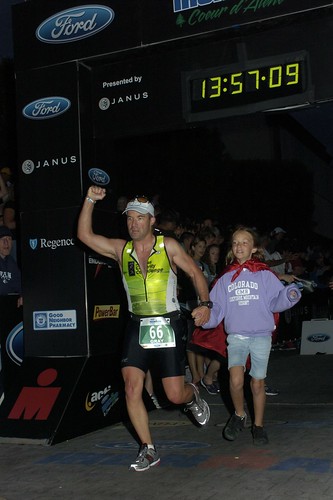
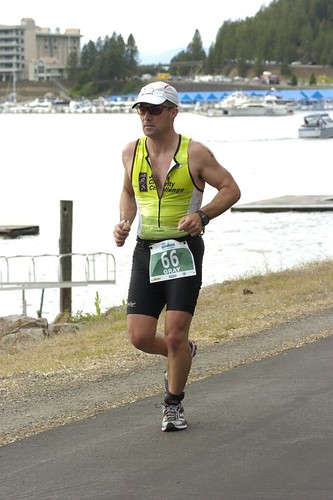
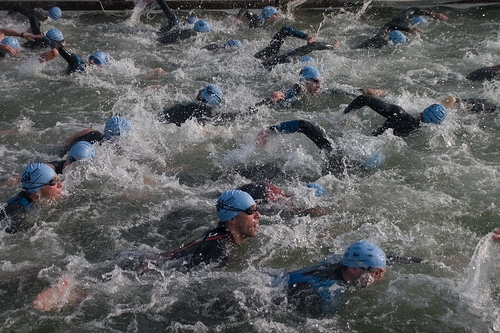
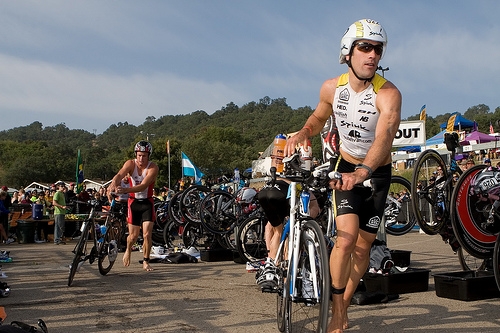
If you take over 13 hours to race an Ironman, you will be watching the sun drift lazily and reluctantly below the mountains as you finally turn around between miles 20 and 21 on the run course in Idaho. The lake shimmers like molten gold, and if you're as lucky as we were, a breeze blows off the water with the promise of a cool night ahead. It is at this point that things start to really improve. Lies and pain give way to truth and painful joy.
For much of the previous hours, you have been fighting big negative thoughts with little rhythmic ones.Some people would say it is the psyche that's picking on you, asking you rhetorical questions that have no purpose on a race course, questions like:
For much of the previous hours, you have been fighting big negative thoughts with little rhythmic ones.Some people would say it is the psyche that's picking on you, asking you rhetorical questions that have no purpose on a race course, questions like:
"What are you doing?"
"You've already done one of these. What's the point? Look at those people already finishing. You'll never be as fast as they are, even if you quit your job and trained full time."
"If you're going to be THIS slow, you might as well walk. Why keep on running?"
"Nobody will care if you quit."
It might be the psyche--it might be Lucifer. Whatever. It serves no purpose for good. You will care if you quit. You know it beyond certainty, and you complain to yourself when you walk. So you drown out Lucifer--or yourself--with white noise--little thoughts as simple as the rhythm of your foot strikes and the song in your head.
"I'm gonna break
gonna break my
gonna break my rusty cage and run."
gonna break my
gonna break my rusty cage and run."
And as the sun finally disappears into twilight, the road tips up as you come back into town for the final time.
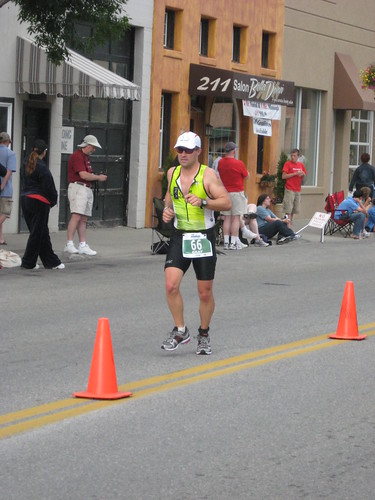
You can see the towers from the resort on the skyline, and you know you will reach them. That is where you will finish. The course is mostly quiet now. Many of the neighbors have gone inside for the night. You can see them through their windows. But some are still there. Someone who has been in their front yard all day cheering Ironmen in all shapes and sizes tells you it is 1.7 miles to the finish. Someone else is there later to tell you it is 1.2 miles. Yet again, another man on a bike, who has been in the same spot since you last saw him more than an hour ago, says, "Three more turns. You've got this. Good job." And one more angel whom you encounter unawares says, "six blocks; only six blocks."
You can hear the music and the loudspeakers and see the lights, and like whirling faster and faster down a funnel, it gets tighter, narrower, crazier and louder until you are just carried along. Somewhere you hear your name shouted and your child grabs your hand. Both of you are swept down the chute:
And even though the earth tilts sideways and your body starts to chill and shake and shiver, you know.
You know that those questions in your head were nonsense, lies that only seem true under stress.
You know that you'll do this again.
And you know why.
Because seeking comfort and avoiding pain are suitable motivations only for lower animals, not for human beings bearing the image of God.
Because pain and risk are the worthy price for taking the gift of life and using it.
Because burying the gift of your one and only life in the ground rather than drinking it dry and sucking the marrow from the bones is a sin.
Because $10,000 raised to fight the disease that grips your wife is only just beginning.
Because the reward of the hard journey is far better than the anesthesia of couch and table.
Because the happy few that live the adventurous life never let you feel alone.
Because everyone gets 60 minutes per hour to journey toward the future, and those 60 minutes should be full to overflowing.
Because the broad and plain highway does not go to your desired destination. The traffic is awful and the scenery sucks.
Because the narrow way is beautiful.
Because, you need it.
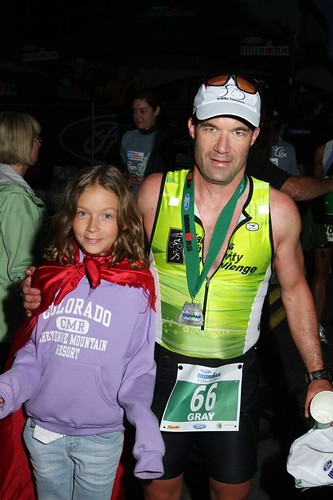
Because you're an Ironman.









 Posts


